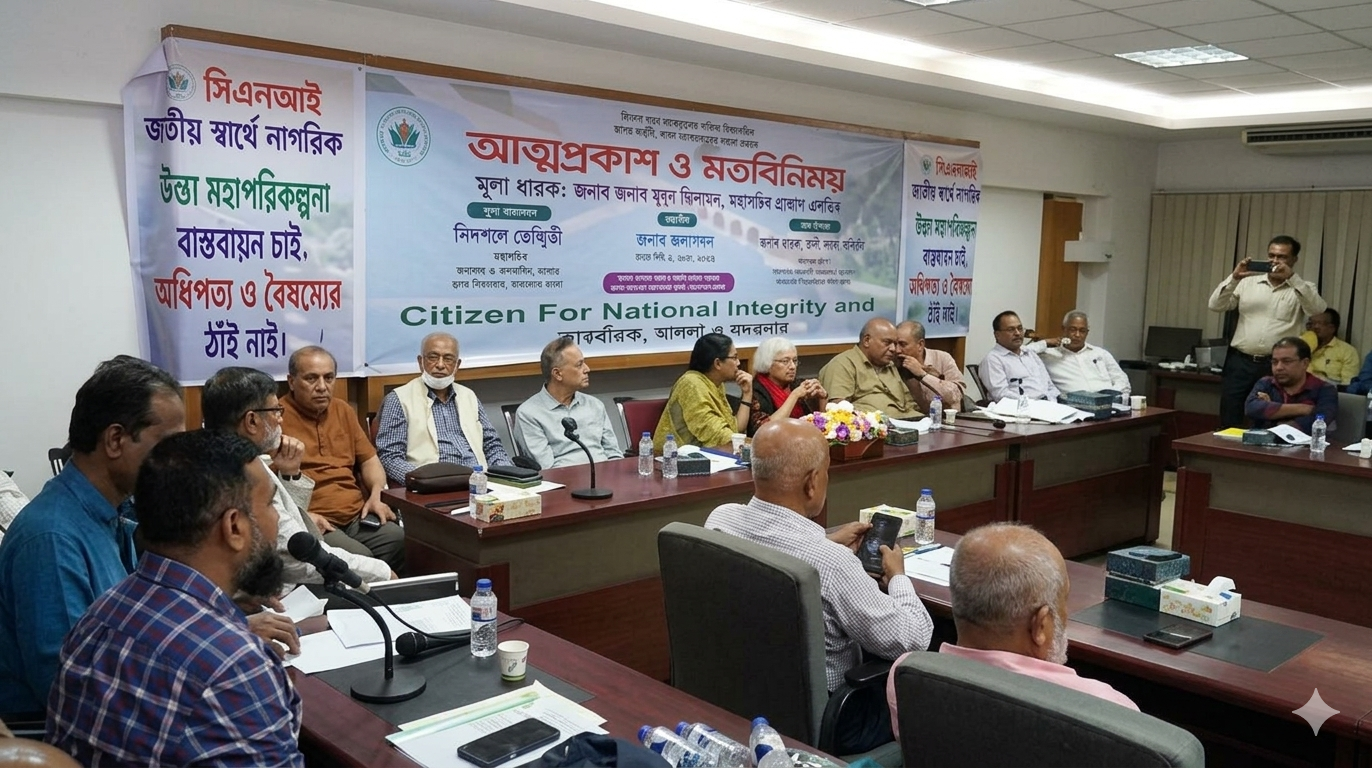
Dhaka: A civic platform, Citizens for National Interests, was launched on Saturday with a pledge to put Bangladesh’s long-term national interests above partisan, personal and group interests.
The launching ceremony was held at the National Press Club in Dhaka.
The platform brings together youths, researchers, professionals, journalists and policymakers, aiming to contribute in building a prosperous, just, secure, sovereign, democratic, sustainable and globally respected Bangladesh.
At the programme, CNI president Rieta Rahman said a coordinated national initiative was needed to address the country’s territorial and strategic vulnerabilities, including river and water crises, border concerns, the Rohingya and Arakan crises, unrealised maritime and regional connectivity potential, institutional corruption and weak local governance.

‘CNI is not a political party and will not be a tool for any partisan interests,’ she said, adding that it will be an independent platform for research, strategic foresight, citizen participation, constructive policy dialogue and assessment of national interests.
Rieta, a journalist, said the platform would listen to citizens, respect facts and evidence, welcome dissent and work constructively with all institutions and stakeholders in the national interest.
‘Our commitment is clear: knowledge for the nation, honesty for the public good, citizen participation in national affairs and national interest above all,’ she added.
Former Jahangirnagar University professor Dilara Choudhury, the main speaker at the event, said Bangladesh was passing through a moment of crisis.
She expressed hope that the newly launched platform would be successful in addressing the challenges facing the country.
CNI secretary general Nurul Huda Milu Chowdhury said the platform would research, analyse, define and advance Bangladesh’s national interests through independent policy research, strategic research, economic analysis, citizen engagement, public dialogue, policy innovation and constructive engagement with policymakers and institutions.
CNI vice-president Captain Rezaul Karim Chowdhury said Bangladesh needed a new culture of strategic thinking linking security with development, water with diplomacy, communications with sovereignty, anti-corruption efforts with national development, and local government with national stability.
He called for strengthening geographical and strategic stability, making transboundary river-water security a national priority, strengthening border management, addressing the Rohingya and Arakan crises and reassessing Bangladesh’s maritime and regional connectivity strategy.
Kedge Business School senior professor Sajjad M Jasimuddin presented the keynote paper, ‘Regional Connectivity and the Course of Action for Bangladesh’.
The paper said Bangladesh’s regional connectivity should not be aimed at moving closer to any single power but should be based on balanced foreign policy, economic interests, strategic sovereignty and regional cooperation.
It said Bangladesh should seek to establish itself as a bridge for trade, connectivity, peace and prosperity rather than a conflict zone by maintaining balanced relations with China, India, the United States, Japan, Europe, Pakistan, Myanmar and other regional partners.