Throughout the nine months of the Liberation War, Khaleda Zia remained under house arrest along with her two children. In the post-war period, on 7 November 1975, Major General Ziaur Rahman became involved in state affairs through the soldiers–people uprising and revolution. He was later elected President of Bangladesh.
However, on 30 May 1981, President Ziaur Rahman was assassinated in a domestic and foreign conspiracy at the Chattogram Circuit House. At that time, Khaleda Zia was an ordinary homemaker, living with her two children at the Dhaka Cantonment.
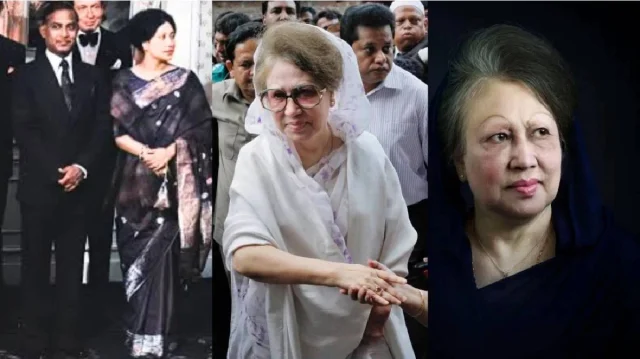
After Ziaur Rahman’s death, the Bangladesh Nationalist Party (BNP) fell into deep crisis, with uncertainty over who would lead the party. Against this backdrop, Khaleda Zia formally entered politics on 2 January 1982 as a primary member of the BNP. Within a short period, her political acumen and organizational skills gained recognition within the party.
In March 1983, she became Senior Vice Chairperson of the BNP. Earlier, on 8 January 1982, in a statement she said:
“President Ziaur Rahman founded the Bangladesh Nationalist Party with the aim of uniting the entire nation on the basis of Bangladeshi nationalism and building an exploitation-free, corruption-free, and self-reliant country.
For some time, I have been closely observing the activities of the BNP. Fearing that the party’s unity and cohesion might be endangered, I have been requested to assume responsibility. Therefore, in the greater interest of the party, I have joined the BNP and become a candidate for the chairperson’s post. My goal is to work selflessly in the interest of the country and the nation, and to uphold unity and solidarity in the party founded by Shaheed Zia.”
When Justice Abdus Sattar fell ill, Khaleda Zia assumed the role of Acting Chairperson of the BNP on 12 January 1984. On 10 May of the same year, she was elected Chairperson unopposed.
She was subsequently re-elected as Chairperson for the second time at the party’s fourth council on 1 September 1993, for the third time at the fifth national council on 8 December 2009, and for the fourth time at the tenth council on 19 March 2016.
From the moment she took charge of the party, Khaleda Zia led an uncompromising movement against the autocratic rule of Hussain Muhammad Ershad. Refusing any form of compromise, she intensified the mass movement through continuous agitation. From 1987 onward, she called for a one-point movement demanding “Down with Ershad.”
After a long struggle, the BNP secured a majority in the national parliamentary election held on 27 February 1991.
In 1991, with the support of Jamaat-e-Islami, Khaleda Zia became Prime Minister of Bangladesh for the first time. She was elected Prime Minister for the second time on 15 February 1996, and for the third time in 2001 after contesting the election as part of an alliance.
Khaleda Zia also played a significant role on the international stage. She served twice as Chairperson of the South Asian Association for Regional Cooperation (SAARC). In electoral politics, she holds a unique record: she contested 23 seats in five national parliamentary elections and won every single one of them.
During the military-backed caretaker government of the “One-Eleven” period, Khaleda Zia was arrested on 3 September 2007. After a prolonged period of imprisonment, she was released on bail through legal battles. During that time, attempts were made to send her into exile abroad, but she refused to leave the country.
On 13 November 2010, during the tenure of the Awami League government, she was evicted from her residence in the Dhaka Cantonment. Khaleda Zia alleged that she was forcibly removed from the house, where she had lived for 28 years. After the assassination of Ziaur Rahman, the then President Abdus Sattar had allocated the residence to her in her name.
During the Awami League government’s rule, a total of 37 cases were filed against Khaleda Zia. She was convicted in the Zia Orphanage Trust and Zia Charitable Trust cases. Later, on 6 August, her sentence was remitted by an executive order of the government. Subsequently, on 27 November, she was acquitted in the Zia Charitable Trust case.
From the very beginning of her political journey, Khaleda Zia became known as an uncompromising leader through her role in movements against autocracy. During the anti-Ershad movement, she was arrested on 28 November 1983, 3 May 1984, and 11 November 1987. She was also imprisoned during the One-Eleven period. Despite pressure to leave the country, she never went into exile.
Over the past one and a half decades under Awami League rule, she repeatedly faced imprisonment and intense political pressure. BNP leaders have alleged that efforts were made to gradually push her toward death while she was in prison. Although appeals were made to send her abroad for advanced medical treatment, the government did not respond.
Most recently, following the fall of the Awami League government, she was released on 6 August by order of President Mohammed Shahabuddin.